
Wall Hanging
The Biggest Mistakes People Make When Hanging Heavy Artwork
Heavy artwork is how a lot of people meet physics for the first time. It looks like a hanging job; it's actually a small structural project — and the mistakes we see (and fix) follow a pattern.
If you've got a statement piece waiting to go up, here's the list of what not to do.
Mistake #1: Trusting the Wire
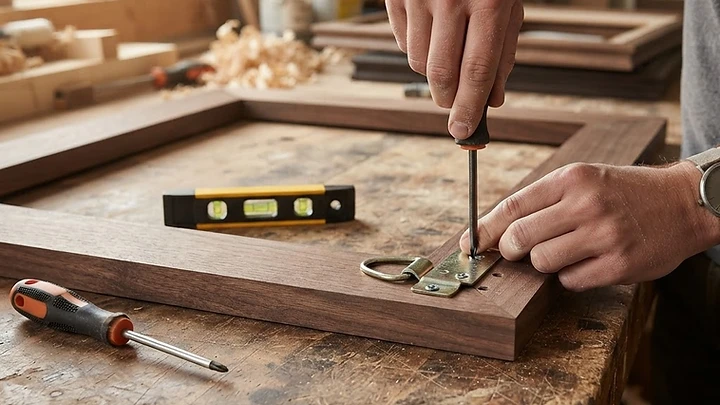
The wire across the back of a frame is convenience hardware, not structural hardware. For a heavy piece it's a pivot that lets the art swing, walk itself crooked, and saw against a nail. Heavy frames hang from the D-rings, from two points — the wire's job is over.
Mistake #2: The Junk-Drawer Anchor
The plastic sleeve anchor from the hardware drawer is rated for a picture frame, not a 30-pound framed canvas — and definitely not the 40+ pound statement piece someone's about to put on it. Hardware needs to match the actual weight, and on drywall that means rated metal anchors at minimum. Past a certain weight, it means studs or backing — no anchor makes drywall structural.
Mistake #3: One Hook Holding Everything
One nail holds weight. It cannot hold weight and stay level — the frame rotates around that single point with every door slam and breeze. Two points of contact are the fix for the weight and the crookedness at the same time. (More on why things go crooked: why your pictures keep going crooked.)
Mistake #4: Eyeballing the Height
The most common placement mistake: hanging art where it feels right standing up — which lands it at standing eye level and leaves it floating high above the sofa, disconnected from the room. The rule that fixes it: center of the piece around 57–60 inches, tied to the furniture below it.
Mistake #5: Skipping the Template
"Heavy" and "guess" don't belong in the same install. A paper template taped to the wall costs ten minutes and prevents the whole trial-and-error cycle — extra holes, weakened drywall, patching, repaint. For a heavy piece there should be exactly one set of holes in the wall when it's done. If there's a better argument for planning than the dry-run method, we haven't heard it.
Mistake #6: Treating Every Wall the Same
Plaster walls in the older homes around the square don't take the same anchors as drywall — the wrong hardware cracks the plaster around the hole. Brick and stone take masonry anchors. Tile needs a diamond bit and a steady hand. The hardware follows the wall, always.
Mistake #7: Hanging It and Never Checking the Frame
Heavy frames flex, and the first week under load tells you what the hardware really thinks. A quick check after a week — still level, tight against the wall, no gaps — catches a slow failure while it's still a quarter-turn fix instead of a falling piece.
The Bottom Line
Heavy art hung right reads as intentional and stays put for years — that's the full method in our heavy artwork guide. If the piece is heavy, expensive, or simply important, that's exactly the job we show up for. Get a quote or read about our picture hanging services in Granbury.
A Couple Studs
A family-run TV mounting and wall hanging business serving Granbury and Weatherford, Texas. One Stud Teaching the Next — every job teaches the next generation the value of doing it right.
Get a QuoteReady to Hang It the Right Way?
A Couple Studs serves Granbury and Weatherford, Texas — get your free quote.
Got a wall? We've got a Stud.
Get your free quote from A Couple Studs — professional TV mounting and wall hanging in Granbury and Weatherford, Texas.